
The new good writing is bad writing
When my TEDx talk went live online, I got a number of emails from people promising to increase the number of views for my talk. I’d got to 7,000 by my own efforts, but the curve was flattening out. So I opened the emails and read them.
The one I replied to was from a man in northern Ireland. It was not perfectly crafted; it contained run-on sentences and other errors. Three years ago, I probably would have dismissed it for that reason. Three months ago, its imperfections were a guarantee of authenticity.

Real or plastic?
Imagine seeing from a distance a garden filled with dazzling flowers. How close do you need to get before you realize the flowers are plastic? There’s a point where something tells you something’s not right, and then a point where your perception that the flowers are fake becomes definite and conscious. Even if you haven’t come close enough, or if you don’t know enough about flowers, to spot the difference, your imaginative intelligence registers the difference between real and ersatz, between organic and lifeless.
It’s the same with AI writing. Many of us are able to detect AI writing easily; others detect it subliminally. Current research says that humans are able to detect AI writing only 53% of the time—but that figure, like all statistics, is shaped by the test. We were taught in school to rely on our rational intelligence to make judgments; if we can’t substantiate the judgment, we usually don’t offer it. It takes both courage and a valued, cultivated imaginative intelligence to offer a judgment based on intuition. I wonder how much of the 47% might have answered differently if the question were not “Was this written by AI?” but “Do you have any doubt whether this was written by a human?”
But hey, I’m not conducting those tests.
I’ve spent my entire professional career improving grammar and word choice, correcting spelling, regularizing punctuation, smoothing out bumps in narrative and argument. I am a fan of writing that allows the story or the argument to come through clearly, without distracting the eye or muddying the view. Writing is like a window: scratches and stains pull your attention to the glass, away from what you are wanting to see through the glass. (Of course, the window might be made of stained glass or etched with pattern—offering beauty for its own sake, as some writing does. Different situation.)
But what’s the view beyond the window? Beyond AI writing is sterility. Nothing moves—like a shop window of mannequins. Beyond human writing is a living creature, and our surface is imperfect: mottled skin, asymmetrical features, irregular hairiness. Our fingerprints smudge the glass.
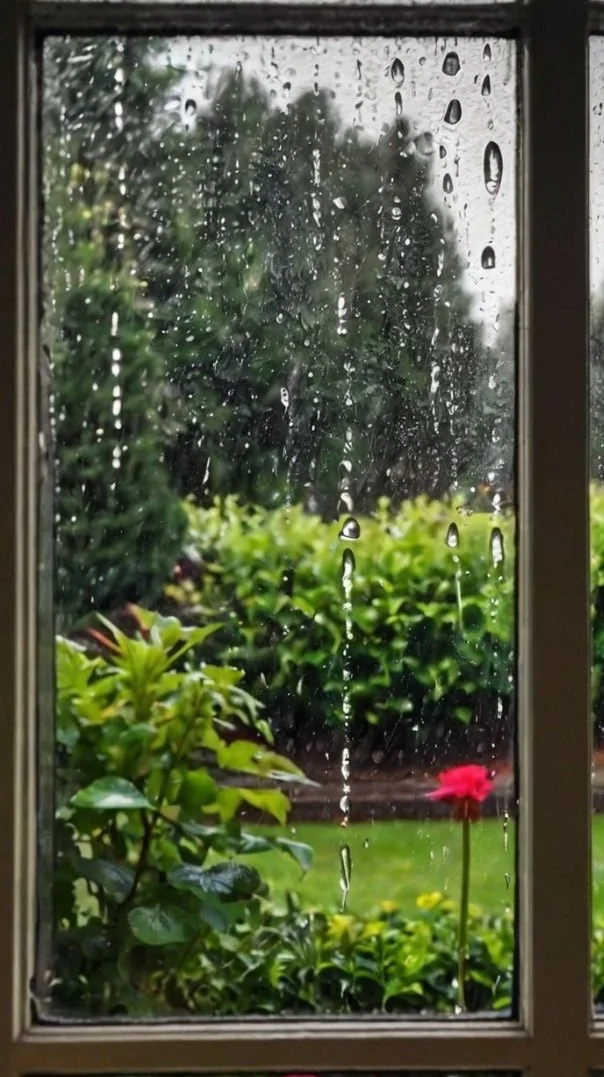
How strange would it be to look through a window at rain and see no raindrops on the glass even though there’s no eave protecting it? We never experienced anything like that until a year or two ago, but AI writing gives us that experience. At first, it’s miraculous. Then we realize we’re in the uncanny valley. And in the uncanny valley, it’s unwise to trust that anything is what it appears to be.
So, I don’t trust those AI-generated emails. I trust the writing with fingerprint smudges and evidence of raindrops. So I wrote back to Gary, and my TEDx talk now has over 50,000 views, just as he promised. (You might suspect those would be bot views, as I did when I first began communicating to him, but I am confident they’re not.)
Does AI marketing writing work? Right now, yes, largely—but, I’m told by those in the business, decreasingly so. Because marketers are marketing to humans, and humans respond to humans, not to bots.
So, what should we be taught when we learn to write? Unfortunately, we’re mostly taught imitation and formula—a dead landscape beyond the window. My dream is that schools would teach techniques to access writing that’s authentic, organic, imaginative, full of life. That’s the goal of Imaginative Storm: to move the cultural needle, even a little bit.