
Creative fear: Why the things we fear the most may be the things worth writing about
A guest post by Imaginative Storm writer Alice W. Meadows. Follow her on Substack

I am terrified of bears. I have always devoured reports of bear attacks. I saw a black bear once, about 100 yards away, while hiking in Shenandoah National Park with my family. I’m quite sure if the bear had attacked us, much of that knowledge would have gone out the window. Since we are on the topic, if it’s a black bear, fight back with everything you’ve got. If your opponent is a grizzly, play dead. And if it’s a polar bear, pray.
Besides the mortal danger of bears, as a writer I am vulnerable in a different way. Five years ago, when I decided to treat my writing with the respect it deserves, I joined the Hay House Writer’s Community. One of our first assignments was to sign a contract with ourselves. We booked calendar slots devoted to writing and improving our craft as if they were appointments we intended to keep. Because it scared many of us to even give ourselves permission to do what we said we wanted to do, we also talked about fear.
I never realized how much fear I was carrying around with my writing. Or that fear was at the core of what held me back all those years.
Still, I didn’t want to look at it. I had come to Hay House to learn how to write better and to be held accountable. Looking at fear, I found, was the entrance fee I had to pay to free up my creativity.
Kelly Notaras led us through a laundry list of fears, confident we would find one or two we could identify with. What author is not afraid of not being good enough? What about the fear of failure? Writer’s block?
There is a useful distinction among the types of fears creatives experience. Some fears protect us from doing the work; others protect and inhibit the work from moving beyond the superficial.
Fears that stop us
These are the fears that keep us from beginning, continuing, or finishing. These fears are about protecting ourselves:
Fear of not being good enough—Maybe I’m not really a writer.
Fear of failure—What if nobody wants to read what I write?
Fear of success—What happens if people do read it?
Fear of rejection—What if everyone (agents, editors, publishers, reviewers, readers) says no?
Fear of judgment—What will people think of me?
Fear of comparison—I’ll never write like that.
Fear of being seen—What will people discover about me?
Fear of wasting time—What if all this work amounts to nothing?
Fear of aging out—Is it too late for me?
Fear of the blank page—I don’t know where to begin.
Fear of never finishing—This project is too big.
Fear of finishing—Once it’s finished, I have to decide what to do with it.
Fear of letting go—I can’t control what happens once readers have it.
When we operate out of these fears, we are in our small selves. We censor our work, abandon it, or never start it.
Fears that stop us from going deeper
These fears are about risking ourselves, and they arise when we’re getting close to something true:
Fear of the truth–What if this really happened?
Fear of being vulnerable—What if I say what I actually feel?
Fear of hurting someone—What if telling this story changes someone else’s life?
Fear of exposing ourselves—What if readers recognize me in this character?
Fear of changing our understanding—What if the person I thought was the villain wasn’t?
Fear of discovering something we don’t want to know—What if the story takes me somewhere I don’t want to go?
Fear of getting it wrong—What if I can’t do justice to this person, memory, experience, history, or topic?
Fear of emotional consequences—What will happen to me if I write honestly?
Fear of changing our own lives—What if writing this makes it impossible to continue living the way I have been?
What if we look at these fears as signals? As signposts that tell us: Pay attention. There is something here. Fears are clues to the stakes. Sometimes the thing that scares us the most is precisely the thing we care most about. Maybe we should write about that.
Five years ago, I started looking at some of these fears. I both saw why I hadn’t finished a book and felt daunted by what needed to be addressed. Most fears stem from a feeling of powerlessness. If I put something on the page, I can no longer control what happens to it-or to me- if I publish it. I am like many writers in that the thing I most fear about writing is the thing that gives my writing its greatest power. My voice. It is the vulnerability of writing uncomfortable truths, the contemplation of whether a book is too late to write, or the fear of parental judgment in a memoir that connects me with readers.
I’m learning I don’t necessarily overcome creative fear. I’ve learned to harness it to balance authenticity with sharing my writing, for the one person who might need to read it.
And I would take the whole lot of these fears over running into a bear.
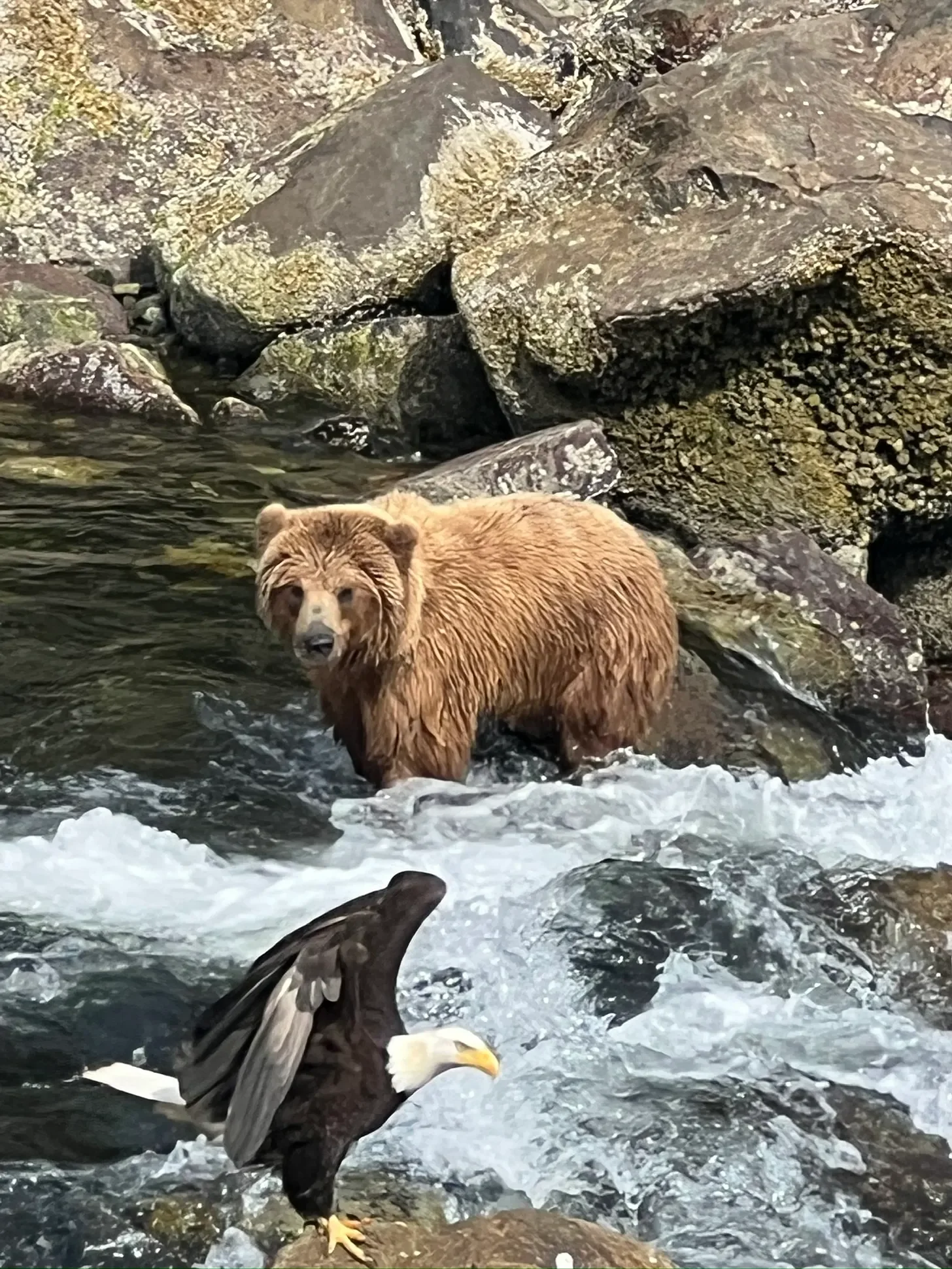
Hidden Falls Salmon Hatchery, Baranof Island, Alaska. Photo by Author.