
Is your imaginative intelligence your soul?
What is a soul, the soul? If you’re religious, you would say it’s the spiritual component of the person that survives death. But even if you’re not religious, as I’m not, the term still has meaning—though it’s hard to pin down quite what that meaning is.
One of the eight definitions in Merriam-Webster is “the immaterial essence, animating principle, or actuating cause of an individual life.” Can you make sense of this? It seems to me that the animating principle, or what I’d call the spark of life, is something more like electricity or oxygen, and the actuating cause is easily explained by the behavior of my mother and father.
What about the immaterial essence? What is it? If pressed, I suspect most people would come up with the definition “the soul.” Which, being circular, is not illuminating.
The mind, as opposed to the brain, is immaterial. Somehow, this agglomeration of matter, chemicals, and electrical energy creates thoughts, desires, philosophies, judgments, and emotions—all immaterial things. I don’t feel that any of those are “the essence” of a person; nor does it feel right to say that the essence of a person is the sum of those things.
When I said that I’m not religious, I mean that I don’t follow any particular religion or spiritual philosophy. Yet I understand, and believe I feel, religious feeling—a connection with something for which I don’t have a word. I tend to go with “the universe,” as many people do, but I don’t feel any connection with the Andromeda galaxy or black holes or quarks. I try “life,” or “all life,” but that leaves out mountains, running water, the moon, clouds and evening sunlight. This makes me a sort of atheistic animist; I don’t believe that all natural things have a spirit, yet they move my spirit—my soul—my self.
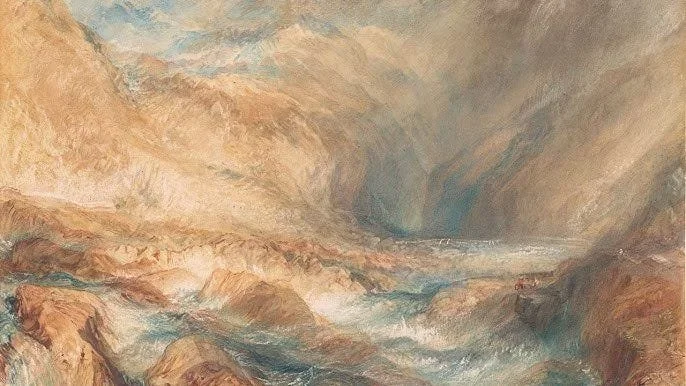
Turner is for me the supreme painter of awe
Maybe you remember that a few weeks ago, I was noodling around with a distinction between ego and self. Ego, which I associate with rational intelligence, is (in this formulation) the consciousness of oneself in the daily world of action and intention and desire. Self, which I associate with imaginative intelligence, is the “who” in “who I am”—what makes me me, what makes you you. The embodied feeling when you “lose yourself” in a state of flow; the sense of congruity when you know you’re on the right path, living your own life and not the life that others expect or command you to live. The sense of aliveness you feel in moments of awe and (often) laughter.
Trying to describe that feeling without assuming some kind of external spiritual force, I come up with this: a respite from ego.
That respite from ego holds a paradox: I “disappear,” but I also feel intensely present, intensely myself. There’s a stimulus of some kind, either an activity I’m involved in or an experience that seems to make time stop—but it’s never the result of willed conscious thinking. So, it’s an expression of imaginative intelligence, which cannot be willed, only invited and allowed. Also, the stimulus that makes me respond that way doesn’t necessarily make you respond that way. So, it’s an intensely individual experience.
This, I’m suggesting, is your immaterial essence. So, in this aspect at least, your imaginative intelligence can be thought of as your soul