
Is your brain all the mind there is?
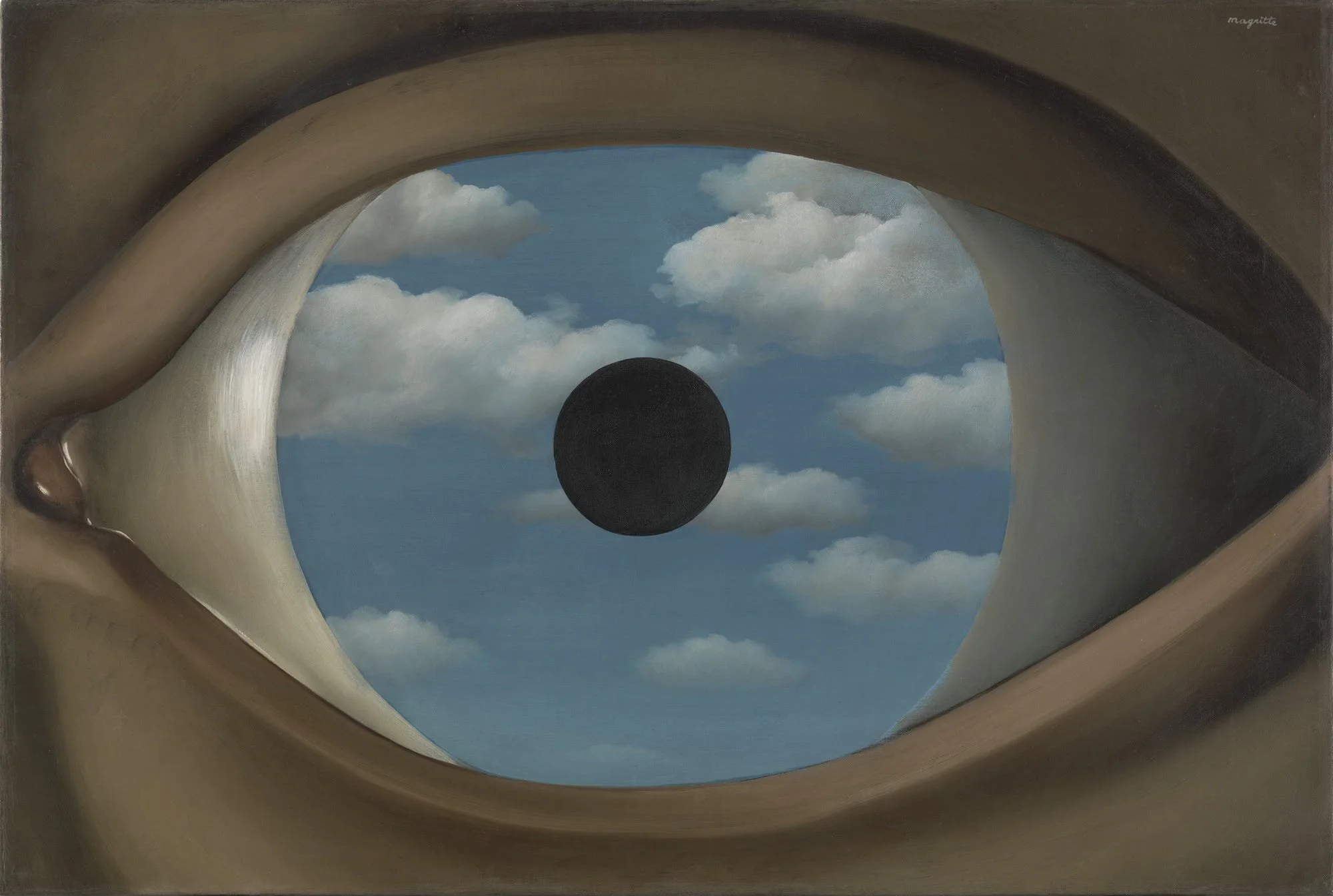
René Magritte, The False Mirror
Beware the unconscious, they say. It’s a forest of triggers, trip-wired by traumas. Complexes grow tentacles in the dark. You’re not yourself when the unconscious takes hold, they say. Bring it into consciousness! Control it if you can! Conscious thought is the only thought that’s truly you.
They’re wrong.
The non-conscious part of your mind is, actually, where the true you resides. It’s just not THAT unconscious, the scary Freudian unconscious. There’s a whole realm in your mind that doesn’t operate in words, that presents you with ideas and insight that you didn’t “think up,” that knows things for no reason you can consciously explain.
But think of how much you “just know”: your values, your morals, your aesthetic taste, your likes and dislikes, your loves and hates, your most heartfelt aspirations, your sense of duty and gratitude . . . You didn’t arrive at any of these by rational thought. They’re just there. And the unique combination of these, and more, is what makes you uniquely you.
Sure, you can bring unconscious traumas and complexes to consciousness, and alleviate them. But there’s a you, a steady core, that wants to do that, that wants to align your thoughts and actions with your inner self. That seems to me to be something different from the unconscious (or subconscious). It’s a core of self whose workings are simply unavailable to the rational intelligence.
It considers itself the proof and justification of life: “I think, therefore I am.” Though philosophy, medicine, and common sense have pretty much concluded that the Cartesian dichotomy between mind and body is nonsense, it lingers. Many of us still conceive of our bodies as, basically, houses for our brains. And by brain, we tend to mean our consciousness.
Because your rational intelligence values consciousness above all, it devalues those mental processes that take place outside consciousness. Intuitions shouldn’t be trusted; trust logic instead. Beauty doesn’t matter; you can’t explain it anyway. Emotions are soft; they just get in the way.
Intuitions, appreciation of beauty, and emotions may not even feel like mental processes at all—but if they’re not taking place in your mind, where are they? Perhaps the cells and nerves that comprise them are actually distributed throughout your body; we do know that you have “brain cells” in your gut. But what are brain cells, exactly, if they’re not in your brain?
So, the brain is not all the mind there is.
“Get out of your head,” you say to someone who’s “over-thinking.” So where should that person “go”? To the body, presumably, but where, and how? That’s never really explained—which makes sense, because the imaginative intelligence doesn’t operate in words. In effect, you’re telling the person that their rational intelligence is not helping and they’d be better off moving into their imaginative intelligence.
And the rational, conscious intelligence is not all the mind there is.
In his brilliant book Thinking Fast and Slow, Daniel Kahneman elucidates two modes of thinking, which map closely onto rational intelligence and imaginative intelligence. Your rational intelligence proceeds step by step, one thought leading to another in a chain, by what it likes to consider logic (even when it’s not objectively logical), reaching a point at which it feels that something is explained or that you know the right thing to do. This is “slow thinking.” Your imaginative intelligence, by contrast, thinks fast. You might call it intuition. You might call it a gut feeling, or “I just know.” Whatever you call it, you can’t trace the steps by which you reached the point of knowing.
You’ve drawn on all kinds of information that you haven’t actually “thought about.” Maybe you’ve picked up some unspoken cues from another person’s body language; maybe some past experience, currently forgotten by conscious memory, is informing your thinking; maybe other stored pieces of information are being called on. Every experience you’ve ever had, everything you’ve ever heard or thought that struck you, has changed you physically in some way, neuroanatomically and neurochemically. This is the database available to your imaginative intelligence, your fast thinking—and it’s vastly larger than the database of information available to your slow-thinking, rational intelligence.
This is why intuitions, cleanly felt, may be more trustworthy than rational decisions. But you won’t feel them if you’re not in touch with your imaginative intelligence, because you’ve allowed your rational intelligence to dismiss it as airy-fairy or woo-woo. And you may have to be vigilant, because your rational mind is capable of inventing an intuition to justify whatever seems, at that moment, to be the most advantageous course—which may actually not be what you want, but rather what you’ve been manipulated to want, by the culture, by advertising, by family or friends, and so on.
Have you ever agonized over a decision and made a list of pros and cons? If you’re like me, the two columns end up about the same length. You probably have a gut sense of what you should do, but you don’t trust it, so that’s why you sought guidance from your rational intelligence. If you continued to mistrust your gut, you probably managed to make the other column a bit longer so you could justify choosing that way. Or, as I did in the best cases, I abandoned the list and went with my gut—what I now know to be my imaginative intelligence.
So what’s unconscious here? The imaginative intelligence, thinking too fast for the conscious mind to track? Or the conscious mind, frequently fooling itself that it has reached a logical conclusion when in fact all it has done is justified a conclusion that seems the most advantageous?
We talk of “the light of consciousness,” which suggests that everything we’re unaware of is dark. And in fact the unconscious does generally seem dark, and maybe the subconscious (basically the same thing) is even darker, since the underneathness of it smacks of hell. But then, what about the flash of inspiration, the flash of insight, which comes from that part of the mind that isn’t conscious? That light is brighter than the rational intelligence’s slow-thinking light, which is more like that exercise machine that when you stop walking the TV (the light) turns off.
When people say things like “I need to find out who I am,” or “I wish I’d lived my own life and not the life others expected of me,” or “I wasn’t true to myself,” they’re describing a distance from their imaginative intelligence. They overvalued what was available to rational awareness and analysis; what seemed, from moment to moment, advantageous.
So here’s the great paradox: when you privilege “consciousness,” you lose consciousness of your self.