
Some thoughts on the pleasures of the mind
And bears watching sunsets
OCT 13, 2025
Before I left New Mexico, I had lunch with the perfectly named Dr. Rex Jung, one of the foremost experts on the neuroscience of creativity. How lucky for me that he is based in Albuquerque! And even better: he believes we are on the right track with our thinking about imaginative intelligence. He agrees that imagination is not a subset of rational intelligence, but something that operates in parallel with it, and though the term “imaginative intelligence” is not used in neuroscience circles, he responded positively to it.
He explained to me the evolutionary advantage of imagination: it allows you to run a scenario in your head before risking it in the real world. We talked about the non-human animals who have imagination: elephants, who grieve—so they must be able to imagine the departed one and her death. And bears, who have been observed to kick back and watch the sunset.
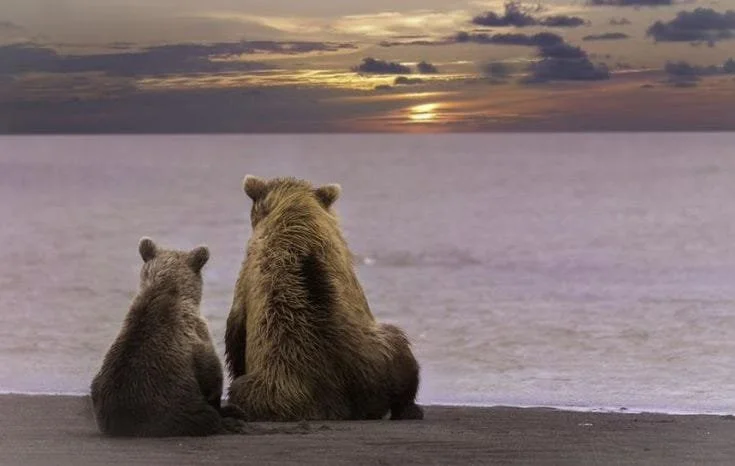
“Why would a bear do that?” I asked Dr. Jung.
Simply for pleasure, he said; to prolong a moment of pleasure. The bear is having fun, just as it would be if it were tumbling and play-wrestling in a sloping meadow. The bear may be enjoying the colors of the sky, the cooling temperature, the stillness of evening and a full stomach, a respite from the needs and alertness of the day.
This got me thinking about pleasure. There are pleasures of the body, and pleasures of the mind—and one word that denotes them both. Isn’t it interesting that we make an equivalence between having our feet massaged, solving a complex problem, immersing ourselves in a creative task, appreciating a painting, and watching a sunset?
So, sensual and sensuous pleasure; intellectual pleasure; aesthetic pleasure; creative pleasure; the pleasure of flow. None of these terms quite captures the pleasure of watching a sunset. It’s changing and disappearing as you watch, but even so it isn’t a bittersweet pleasure (at least, not for me). But it is tied to that sense of evanescence, the preciousness of what cannot last. Like life.
Bodily pleasure is a sensation; but what are the pleasures of the mind? Not exactly an emotional experience, though they generate happiness, satisfaction, contentment. Perhaps they belong in the realm of imaginative intelligence, which has, I believe, a function of informing you, confirming to you, when you’re right with yourself. They are all moments in which time falls away: moments complete in themselves, with no need to be anywhere else, to do anything else, to consider anything else.
Imaginative intelligence, I believe, expresses itself in feelings rather than words. So, when you are fully in your imaginative intelligence, the double-track thinking of the mind quietens. This is the goal of meditation. The power of now. And it amazes me that I have come closest to it not by meditating or reading Eckhart Tolle, but by engaging in a “throwaway” creative practice for 10 minutes a week.
Dr. Jung pointed out that the more you do something with your mind, the more you strengthen the neural connections that perform it. This is what leads me to think that imaginative intelligence is something more than merely creativity. It encompasses all the nonrational ways we engage with the world—including the pleasures of the mind.
It’s old news now that certain non-human animals are “intelligent”: chimpanzees make and use tools, as do crows; pack animals plan their hunts. We’ve moved our concept of human intellligence away from the limited, monolithic idea of IQ, but as we look for intelligence in other species, are we still looking for an equivalent of IQ—our rational intelligence? Might it be that stripping a twig for better termite-fishing requires an imagination to envision a better twig than the one you just broke off the tree? Might the bear have a sense of time, even of mortality, to spice and shade the pleasure of watching a sunset?