
Write Poetry That Says What Only You Can Say

Who This Poetry Writing Course Is For
This poetry writing course is for anyone who has felt that ordinary language wasn't quite enough, that what they meant needed a different shape to hold it. It is for the complete beginner who has always been pulled toward poetry but never knew where to start. It is for the experienced writer who wants to learn poetry at a deeper level and push past their usual moves.
You don't need a degree, a finished portfolio, or a single published line. You need the willingness to read your work aloud and the curiosity to see what happens when you do. If you have ever finished a poem and thought, I want to make something that lands like that, you are in the right place.
Writers arrive here for different reasons, and all of them count. Some want the craft itself: a sharper image, a line that holds, an ending that lands. Some are after something larger, a way to say what they actually mean, a firmer hold on who they are on the page, work that will still be here when they are not. Some are finding their way back after years away from writing. Some want the company of people who take this as seriously as they do. This course was built wide enough to hold all of it.

Learn How to Write Poetry with This Online Course
You already have everything a poem is made from. The image that stayed with you. The thing you have never quite found words for. What is missing is a way in, and a method that gets you there without years of guessing.
A poem follows the same order your own mind does. Something happens, you see it, hear it, feel it against your skin, and that gives you an image. The image stirs a feeling. The feeling goes looking for words. The words carry sound. The sound rides on rhythm. And underneath all of it, your mind is quietly making sense of the whole thing, whether what you're working with is a clear memory or a half-remembered dream.
A finished poem holds all of this at once, the way your body holds bone, blood, and breath at once. But you can't study a body all at once. You look at it one system at a time, then put it back together. That's what this course does with a poem: senses, then feeling, then words, then sound, then rhythm, then the mind that holds it all together. A welcome session and ten sessions after it, one piece at a time, so that by the end you are not guessing at what makes a poem work. You know why it works, and you can do it again.
It's why we call our method Write What You Don't Know. The usual advice, write what you know, is true as far as it goes, since you do have to know something before you can write it. But we mean something more specific: write toward what you just found out, the thing you didn't know a minute ago. Think of it like following a path that dips downhill and out of sight. You don't stop walking just because you can't see where it leads. You keep going, and the not-knowing is exactly where the poem is waiting. To follow the path is to write.
In Imaginative Storm to Form writing, we value your imagination, your emotional honesty on the page, your voice, and your willingness to speak your work out loud. Speaking your words aloud is one of the most underused editing skills you have: your spoken words reveal what works and what doesn't in a way pen and paper alone never will. Practice it regularly and your ability to compose on the page can jump twenty percent or more. As you develop your spoken voice in this course, you'll be astounded how far it takes you in your writing life and career.
All of it runs on your schedule. This is a self-paced online course: every session is a video or audio lesson you start when it suits you, with unlimited lifetime access. Take one a week, one a month, or three back to back. Nothing is live, so nothing can be missed, and you can return to any session as often as the writing asks you to.
Most courses treat poetry as a puzzle to be solved. This one treats it as a practice to live inside. The goal is not one perfect poem. It is a more honest, more precise relationship with your own voice, the kind that keeps producing work long after the course ends.

Online Poetry Class Curriculum
You can expect 10 sessions, each about 90 minutes long. Each session includes a short intro, a warmup prompt, two 10-minute prompts with a shorter list-making prompt between them. (We do the timing for you.) Each session ends with a Surf the Storm prompt to do in your own time.
The course also includes access to the Prompt Archive, so you can hear what other course participants wrote to the prompts you’re working with. (We recommend you listen to these after you write your response to the prompt yourself.)
-
Learn the principles of the Imaginative Storm method which includes: writing by hand, using a timer, writing what you don’t know.
What you’ll learn:
You won’t try to write a good poem. You’ll unleash your imagination — not your judgment and produce original lines.
-
Unlock the creative power that’s been waiting inside you
In this first session, you’ll discover the freedom of writing without second-guessing yourself. You’ll learn simple techniques to tap into your inherent creativity and write poetry like you’ve never written before.
What you’ll learn:
● How to tap into your imagination and write with spontaneity, originality, and creative flow
● How to find your true poetic voice and put your own experience, insight, and feeling into a line
● How to revive images and memories you’ve used before by finding a fresh angle or an untold layer
How to write more freely by letting go of the demand that every line be “good”
-
Unleash your raw, uncensored voice
In this high-energy session, you’ll write without rules or judgment. Poetry is meant to be heard before it’s meant to be understood — when you silence your inner critic, sound and feeling lead the way.
What you’ll learn:
● How to write past your inner critic and get to the raw first draft where the real lines are hiding
● How to let rhythm, sound, and onomatopoeia carry meaning before you’ve found the “right” word
● How to trust your first thought as your best thought, the instinct poets have leaned on for centuries
● How to turn unfiltered feeling into lines with heat, not politeness
-
Write with sensory power
Great poems don’t describe — they land in the body. In this session you’ll work with all five senses, plus the two poets rely on most: memory and intuition.
What you’ll learn:
● How sight becomes insight — training your eye so an ordinary object (a red wheelbarrow, a torn coat) can carry a whole poem
● How to use onomatopoeia, alliteration, and assonance so the sound of a line does as much work as its meaning
● How smell and taste anchor memory more precisely than any other sense, and how to put that anchor on the page
● How to trust intuition as a sixth sense for image-making — the instinct that tells you which detail is the poem
-
Use the details of a place to deepen a poem.
In this session, you’ll learn to let a place hand you its details, rather than reaching for description that could belong anywhere.
What you’ll learn:
● How to avoid descriptions that read like a list, and choose the one or two details that do the work
● How specific, concrete objects carry more weight in a poem than abstract statement
● How a place holds memory and mood, and how to let it do that without explaining it
How to write your way back into a remembered place through the senses, not just the facts
-
Incorporate nature’s power and symbolism
Nature has been the poet’s original material since before there were poems. In this session, you’ll explore how the elements — wind, water, fire, stone — become the vehicles for feeling that can’t be stated directly.
What you’ll learn:
● How to build metaphor from the natural world so it carries emotional weight instead of decoration
● How a single symbol can do more work than a paragraph of explanation
● How to move between the granular (one eagle over one ridge) and the expansive (what that eagle means) inside a single poem
● How to let image do the work that statement can’t
-
See beneath the surface of human interaction
This session explores how a look, a posture, or an overheard line reveals more than direct explanation ever could — and how to get that into a poem.
What you’ll learn:
● How to build a speaker or persona from a few sharp, observed details, the way a stranger’s coat or walk tells a story
● How to capture what’s unsaid between people and let the poem hold the tension instead of narrating it
● How overheard language and rhythm become raw material for a poem’s voice
● How to write from someone else’s point of view with empathy and precision
-
Write from real emotional depth
This session explores how to find the moment that won’t leave you alone, and turn it into a poem instead of just carrying it around.
What you’ll learn:
● How to recognize a “poetic incident” — the moment that demands to be written — and work with it
● How to write toward difficult material (grief, a hard parent, a loss) with enough distance to make art, not just confession
● How writing from another person’s vantage point can reveal what you didn’t know you understood about them
● How restraint, more than explanation, is what makes an emotional poem land
-
Use personal experience to deepen a poem
Your own life is your richest material. In this session, you’ll learn to mine it with the same rigor you’d bring to any other subject.
What you’ll learn:
● How to choose the one detail that carries an entire memory, instead of trying to include all of it
● How the “why” behind an experience, not just the “what happened,” is what makes a personal poem resonate
● How to find the emotional arc inside a memory before you start writing the poem
How to write your own history without flattening it into summary
-
Build a turn into your poem
A poem needs a turn the way a story needs a change — the moment where something shifts and the poem earns its ending. This session covers how to find that turn and build toward it.
What you’ll learn:
● Why plot isn’t just for fiction — how a poem needs the same sense of stakes and movement
● How to recognize the turn inside your material, the shift that gives a poem its reason for existing
● How to build momentum line by line so a reader leans in rather than drifts
● How to end a poem so it feels finished, not just stopped
-
Use contradiction and paradox to add dimension to your poem
Paradox is where poetic imagination catches fire, and where readers lean in. This session teaches you to hold two truths in a single line.
What you’ll learn:
● How contradiction fuels image-making, the way “be still my beating heart” means two things at once
● How to build metaphor and simile that link things that don’t obviously belong together, and make the link feel inevitable
● How to let a poem hold ambiguity instead of resolving it too neatly
● How to write an ending that surprises without cheating the poem that came before
How This Poetry Course Works
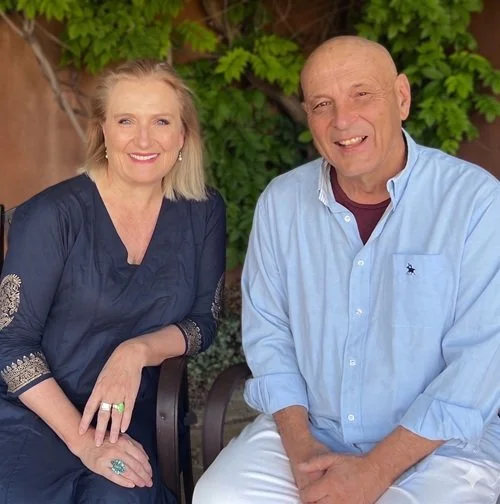
Each audio or video session is led by James Navé and Allegra Huston. The progression is simple, and it works. You write from timed prompts that quiet the inner critic and drop you into the flow state where real poems arrive. You receive craft instruction. Every session sends you off with new poems, not exercises, but work worth keeping and shaping further.
None of this has to end when the last session does. A free Writing Circle gathers writers each Saturday, virtual intensives give you a concentrated afternoon, the 10-Week Writer Training pushes harder over ten weeks, and retreats hand you days at a time.
Meet Your Poetry Instructors
James Navé is a working poet with an MFA in Poetry from Vermont College of Fine Arts and more than twenty years spent making, teaching, and coaching poems. His book 100 Days — poems written daily while recovering from cancer surgery — grew out of the same method taught in this workshop.
Allegra Huston brings an editor's ear to the table. Oxford-educated, she spent four years as Editorial Director at Weidenfeld & Nicolson, where her work was to hear what a sentence was trying to do and help it do that with less. She and James co-teach through Imaginative Storm.
Together, they've taught hundreds of writers to turn short, fearless bursts of writing into real, lasting poems.

Ready to Get Started?
If you have been waiting for permission to take your poetry seriously, here it is.
Purchase the full course now and save 25%! $399 $299
What You Get:
Unlimited lifetime access
You will also receive a downloadable pdf of the book Write What You Don’t Know. It is included at no extra charge.
Money Back Guarantee
If you are not satisfied with the course, let us know and we will gladly refund your money.
Not sure if this course is for you?
You can purchase just the Welcome Session and Session One for $39. If you like it, you can then purchase the rest of the sessions for $360.
What Our Poetry Writers Say
-
![]()
“You helped me overcome my critic. I went from being a fearful writer to a joyful one.”
— Corinne Crone, intimacy coach
-
![]()
"The Imaginative Storm helped me go places I would not normally consider going and kept me from overthinking when I got there. The number of poems from the Imaginative Storm that have been published speaks to the success of the method and its benefit to me as a poet.
— Louis Faber, poet
-
![]()
“This wave of words came in 10 minutes in a beautifully playful space. I find the Imaginative Storm method intriguing, freeing, well-seasoned and lovingly crafted. I am delighted, surprised and nourished every time I jump into it!”
— Esme Olivia, singer/songwriter
-
![]()
“The unknowing of what 'comes next' is a treasure not a burden. As I learn more and more of what I don't know, it brings me joy and a greater palpable connection with the ordinary that enables me to see the beauty and majesty in every little or monumental thing.”
— Genevia Hendry, writer
-
![]()
"At least a dozen poems in my most recent book, Notes from Paradise, would not exist if it had not been for the prompt, the word list, and the 10-minute writing time. They are all briefer, slimmer, and taller in appearance than the ones I write on my own.
— Elaine Heveron, poet
In-Person Poetry Writing Retreat
Looking for an in-person immersive poetry writing experience? Join us in legendary Taos, New Mexico, and let the creative energy of the mountain inspire you.